
Treatment
Keratoconus & corneal cross-linking
Keratoconus is a condition in which the cornea gradually thins and bulges into a cone. Corneal cross-linking strengthens the cornea to slow or stop that change — the earlier it is found, the more vision can be protected.
What keratoconus is
The cornea is normally a smooth dome. In keratoconus its fibres weaken, so it thins and pushes forward into a cone shape. Because the cornea does most of the eye’s focusing, the result is blurred and distorted vision that glasses correct less and less well.
It usually appears in the teens or twenties and can progress for years. Frequent eye rubbing and allergies are linked with it, and it can run in families.
Signs worth checking
- Blurred or distorted vision, often worse in one eye
- Glasses prescriptions that keep changing, especially rising astigmatism
- Glare, halos or “ghost” images around lights
- A teenager who rubs their eyes a lot and complains of blur
How cross-linking works
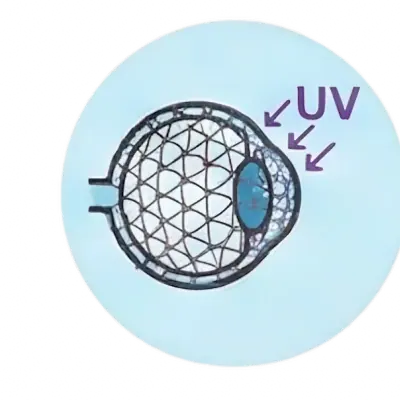
Riboflavin (vitamin B2) drops are applied to the cornea, which is then exposed to a controlled ultraviolet-A light. The combination creates new bonds between the collagen fibres, making the cornea stiffer and more stable.
Cross-linking aims to halt progression; it does not reverse the shape that has already changed. Vision afterwards is usually corrected with glasses or special contact lenses, and other options may be discussed for more advanced cases.
Why keratoconus is not treated with LASIK
LASIK works by removing corneal tissue. In an eye with keratoconus the cornea is already too thin and weak, so LASIK is not suitable and could make the condition worse. This is one of the reasons we map every cornea before any laser vision correction.
Read about LASIK and who it suits
Recovery
- A protective contact lens is usually worn for a few days
- Light sensitivity, watering and discomfort are common in the first days
- Vision can be blurrier for some weeks before it settles
- Regular follow-up scans check that the cornea has stabilised
Common questions
Will cross-linking make my vision perfect?
Its goal is to stop the keratoconus getting worse. Some people notice a small improvement, but most still need glasses or contact lenses afterwards.
Should my children be checked?
Keratoconus can run in families. If a parent or sibling has it, an eye exam with corneal imaging is a sensible step, especially in the teenage years.
Does eye rubbing really matter?
Yes. Persistent hard rubbing is associated with keratoconus getting worse. Treating itchy, allergic eyes helps.